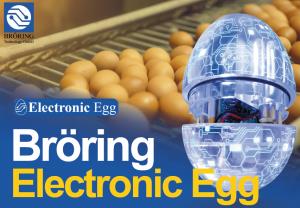
 After three years of intensive development, Bröring Technology GmbH has introduced their electronic egg that identifies points of potential shell damage in conveying product from nests to graders. The innovation will be demonstrated on Booth B4062
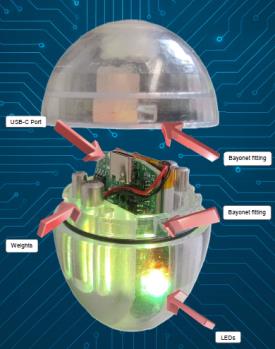
The Bröring electronic egg is unique in providing a real-time color display. Interaction of the egg with the sides of conveyers, corners, junctions and transition points that result in damage results in activation of LEDs visible through the transparent “shell”. Surface impacts that could damage shells are denoted by a red color. A green color indicates acceptable, non-damaging force with intermediate shock resulting in an amber display. This unique visible real-time feature allows observers to rapidly identify problem areas along the conveyer line in order to effect adjustments or repairs.
The Bröring unit simulates an egg in size and weight and continuously logs stress by time and hence location, registering the intensity of G forces and shocks (jerks, impacts, vibration and acceleration) that can result in invisible but cumulative damage and extending to obvious cracks. Data recording forces in three axes are stored by the egg, to be retrieved and exported to compatible devices using iOS, Android®, Windows®, macOS and iPadOS.
Applications for the U.S. market include:
- Large in-line complexes with up to three million hens can benefit from the Bröring electronic egg. These operations through design and layout have long conveyors from the elevators to the packing plant. Maintenance teams could justify an electronic egg to regularly monitor alignment of conveyors including corners and junctions where damage occurs. It is considered justifiable for any in-line aviary or cage complex to own and operate an electronic egg especially with hens held in as many as ten free-standing cage houses or multi-level units.
- Owners of a number of small complexes that may not exceed can reduce losses using the Bröring electronic egg. Technical and service personnel can conduct diagnostic or quality-control procedures at monthly intervals or as indicated by an increase in downgrading due to shell cracks.
- Operators of packing plants receiving eggs from contractors can monitor the equipment used by suppliers. On farm equipment including conveyors and farm packers may be defective. In addition the Bröring electronic egg can identify problems in transport and handling during loading on the farm.
- Suppliers of egg conveying installations in the EU use the Bröring electronic egg to certify initial operation during commissioning and thereafter during warranty and service visits.
- Poultry health diagnosticians can use the Bröring electronic egg to investigate high levels of downgrades due to shell cracks with special reference to aviary housing. Data provided by the Bröring electronic egg is frequently combined with the results from the Bröring Egg Shell Strength instrument to ascertain the causes of shell downgrades.
- Suppliers of grader installations can identify defects in conveying with specific reference to transition to the receiving table.
- Primary breeders, research and educational institutions have applications for the Bröring electronic egg.
To determine the return on investment from the Bröring electronic egg, a landed cost of $3,000 is assumed. The annual cost of operation including fixed items (depreciation, interest and fixed maintenance) would amount to $810 per year. The unit cost of an evaluation would depend on frequency of use. Assuming 24 assays per year, the unit cost would be an inconsequential $35 per survey.
The impact of shell damage can be assessed on an individual farm basis and would depend on production volume and obviously the differential between nest run value for saleable eggs and breaking stock. Assuming a value for nest run at $1.00 per dozen and breaking stock at $0.70 per dozen, the loss due to a cracked egg would be $0.30 per dozen. A complex holding one million hens would produce 800,000 eggs per day. For each one percent downgrade, the complex would lose 8,000 potentially salable eggs each day or 666 dozen. The loss for each one percent of production that cannot be packed would be approximately $200 per day or $73,000 per year.
|
If the electronic egg can identify defects in the conveying system or in transport or at entry onto the grader at a cost of $30 for the equipment plus the time expended by a technician, and if repairs or adjustments are made, the return is infinite. Improperly designed or installed aviaries and conveying equipment, can result in downgrades due to cracks in excess of five percent of production. This is especially the situation in old flocks and during summer when respiratory alkalosis results in deterioration of shell integrity. Eggs from older hens and during extremes of temperature are susceptible to shell damage.
Dr.-Ing. Stefan Bröring will be present on Booth B4062 at the IPPE to demonstrate the innovation that is now used extensively in western Europe with benefits for packers, independent producers who are paid on the basis of salable eggs and for larger operations intent on optimizing shell quality and margin.
|
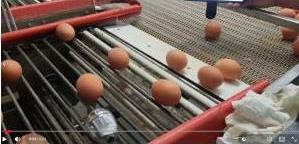
Click here for video |